

Writer Erwin Mortier returns to his former workplace after 30 years and once again delves into the depots of the Dr. Guislain Museum: “For more than 150 years, Ghent's ‘Hospice Guislain’ has offered mental care, shelter and refuge. For nearly 40 years it has also housed a museum, preserving an extensive collection of historical testimony and continuing to uncover new stories. A Home of One’s Own proudly displays a diverse selection of preserved artifacts, including photographs, books, artwork, archives and more. The exhibition takes a personal approach and deviates somewhat from the traditional paths, as we all might do from time to time. From a dreamy warehouse where furniture, kitchenware and sculptures remain to seas of letters and diaries - it all gets a home in A Home of One’s Own.”
“I wanted to bring an exhibition that first and foremost takes pleasure in the exhibiting itself, a pleasure that also shows great seriousness.”


Dubbelklik om te bewerken...
The Expo Vol. at A Home of One’s Own
on view from 18.09.2026
It used to be a full room, just as it is now - -a room that remains fulfilled.
Erwin Mortier has reopened his exhibition A Home of One’s Own at Dr. Guislain Museum to nine artists and their works, inviting them to intervene in the space. Through many unexpected encounters, a space within the existing space has begun to evolve, turning into the Unheimliche within the Heimliche.
The objects in this busy home are thus displaced, reinterpreted, and appropriated through their dialogue with the new inhabitants. The hope is that, when this intangible dialogue finds its place, the movement - or the unconscious - of this house, a locus both of psychiatry and art throughout its history, may also be touched. Such resonates with a warning given by Lacan (1969): we must never treat the unconscious “like the amber which holds the fly so as to know nothing of its flight.”
(“tels que l’ambre gardant la mouche, pour ne rien savoir de son vol.”)
The exhibition emerges from the Lacan Today Conference 2026. The two share a common engagement with psychoanalysis, while remaining distinct and independent from one another.
With works by:
Franck Ancel, a Paris-based psychoanalyst and art historian, collaborates with artists and researchers to explore the intersections of topology, scenography, and zerography: a concept extending Jacques Polieri’s legacy and Lacan’s spatial theories. His recent work includes the group exhibition La topologie mise en Cage (inspired by Lacan’s Seminar XX) and this triptych for Dr. Guislain Museum, created with ceramicist Monica Righi, psychoanalyst Patrick Valas, and publisher Richard Meier, blending sculpture and mapping.
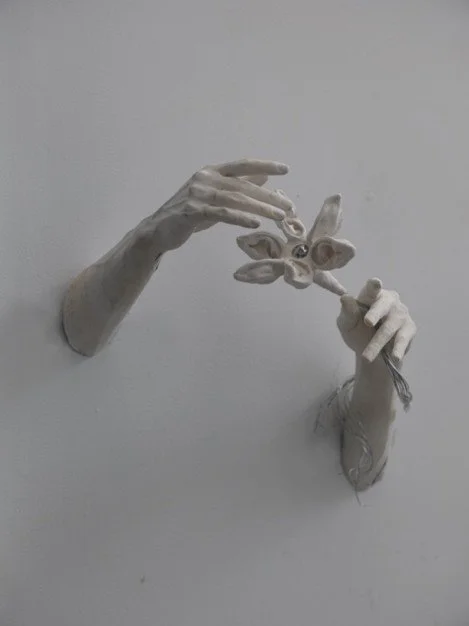
Stephen Benedicto
Stephen Benedicto is a Washington DC – based multidisciplinary artist working across sculpture, photography, and painting. Through the process of life-casting fragments of the body, Benedicto creates surreal composites that model the external world and consider the threshold between the inside and outside of the body. At this threshold, the work asks, “Is there really any difference?” and considers the apolitical implications of asking that question.
Louise Bourgeois (1911–2010) was a French-American artist whose practice explored memory, family, the body, sexuality, and emotional experience through sculpture, drawing, printmaking, and installation. She began psychoanalysis in 1951 and continued it intensively for many years, during which writing became an important part of her practice. For Bourgeois, art offered a way to confront and transform difficult memories and emotions, serving, in her words, as a “guarantee of sanity.”
Antonia Brown is an artist based between Brussels and Cape Town. Her practice extends through sculpture, installation and performance, often involving bending modes of address to histories of femme bodies and spaces through acts of repetition and distortion. Her work GG iii, is pleated from a mould of fashion leftovers - a Givenchy monogram doubling as her mother’s initials. Pleats are made through folding, they render much of the surface not visible. But both continuous and structurally determined with the surface of what is.
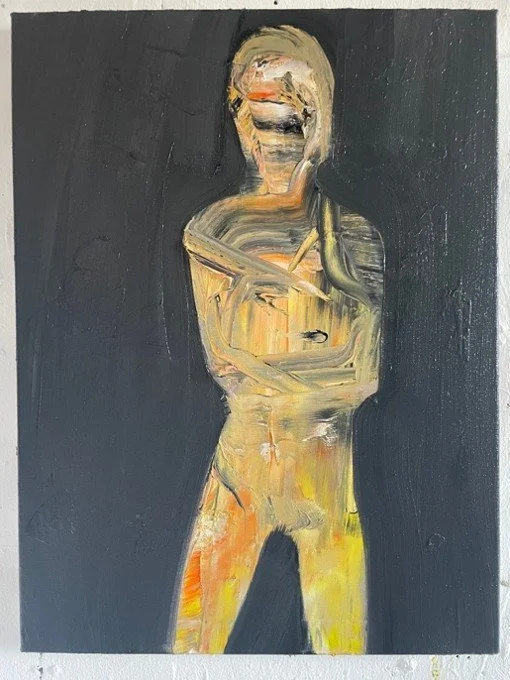
Daniel Coombs
Daniel Coombs, a recognised and committed figurative painter, has long addressed the nuance of the psyche. His paintings of single figures here address alone-ness as opportunity to experience solace, contemplativeness, and pleasure.
Evangelia Danadaki is an artist-researcher working across feminist philosophy, performance and moving image. She is a PhD candidate at the University of Leeds. A love letter was initially staged as a durational performance of reading Jacques Lacan’s Seminar XX. Confronting the text, she resisted voicing it. Filming instead became an experiment in merging Lacan’s diagram of sexuation with her bodily movements. This counter-reading runs within Chapter VII A Love Letter.
Bracha L. Ettinger is an artist, psychoanalyst, philosopher, and theorist whose work brings together painting, psychoanalysis, aesthetics, and ethics. Based between Paris and Tel Aviv, she has developed the influential concept of the “matrixial” gaze and explored trauma, memory, femininity, and the unconscious. Her works dedicated to the exhibition are reflections from her solo exhibition Bracha. The Room Is Shared!, which explores the limits of art and psychoanalysis through private encounters.
Carmen Schmöl is an artist working with language, dance, and Lacanian psychoanalytic praxis.
Amber Wynants works across different media, drawing on the vocabulary of modernist art and design alongside materials associated with domesticity, ornament, and everyday life. By assembling waste, embellishments, and discarded objects, Wynants questions inherited hierarchies of value, how they become embedded in objects, and our emotional attachment to them. Her work explores how meaning and value are produced and perceived, engaging with questions of subjectivation and perception